Sick agent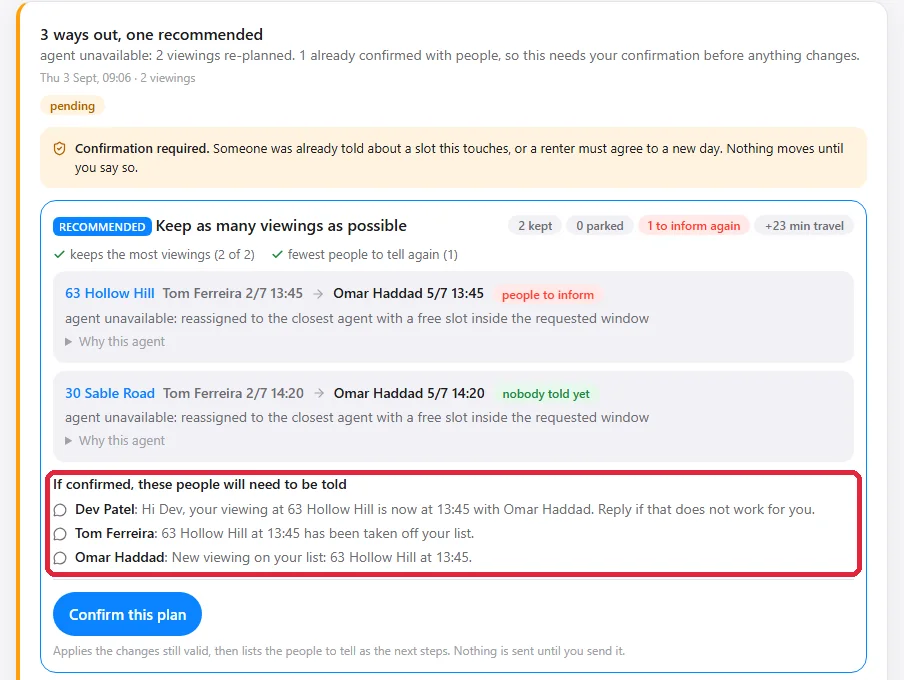
An agent calls in sick at 9am. Two viewings are already promised.
FieldFlow re-plans both, explains every choice, and refuses to touch what people already know until you say so.
FieldFlow re-plans the day before you've finished reading the WhatsApp message, shows you exactly what moves and why, and never touches the VIP viewing you locked. You approve it. It executes. Nobody finds out from a renter standing at a locked door.
The demo is the real product on a demo day, open to anyone, no signup. Click anything. Break the day. Watch it re-plan.
Tom Ferreira calls in sick with two viewings already promised. This is the real product handling it, start to finish, with the founder talking you through every decision. Sound on.
The exact moments a lettings operation loses a landlord, burns a coordinator or sends an agent to a locked door. Pick one. Watch what FieldFlow does in the seconds after: no improvising, no reconstructing, no inventing.
Every screen is the live product on its demo day, Thursday 3 September, 10:40. The red frame marks the detail that matters. Names and addresses are invented.
FieldFlow re-plans both, explains every choice, and refuses to touch what people already know until you say so.
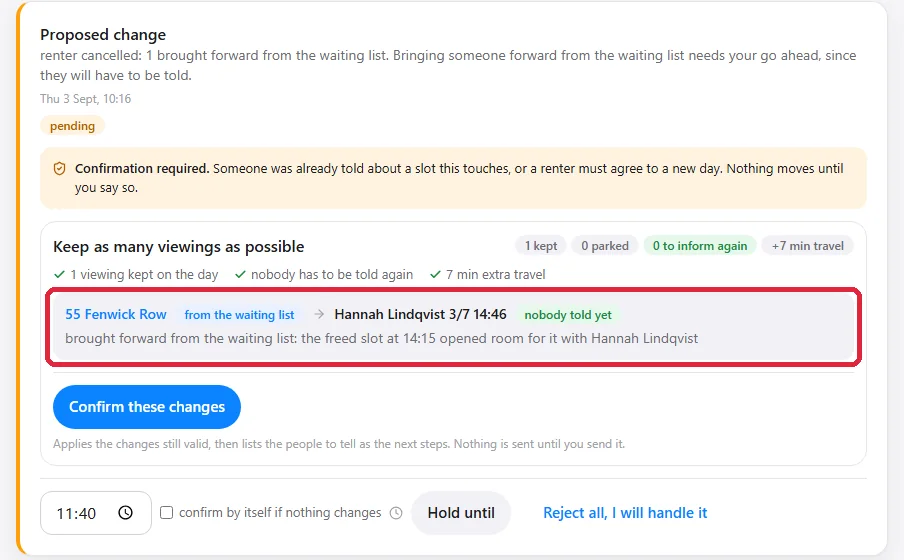
The freed slot goes to the person already waiting for that property, with the right agent, before you finish reading the text.
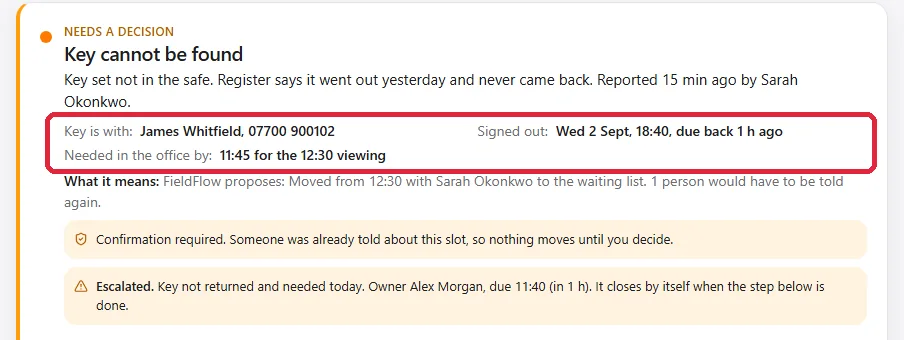
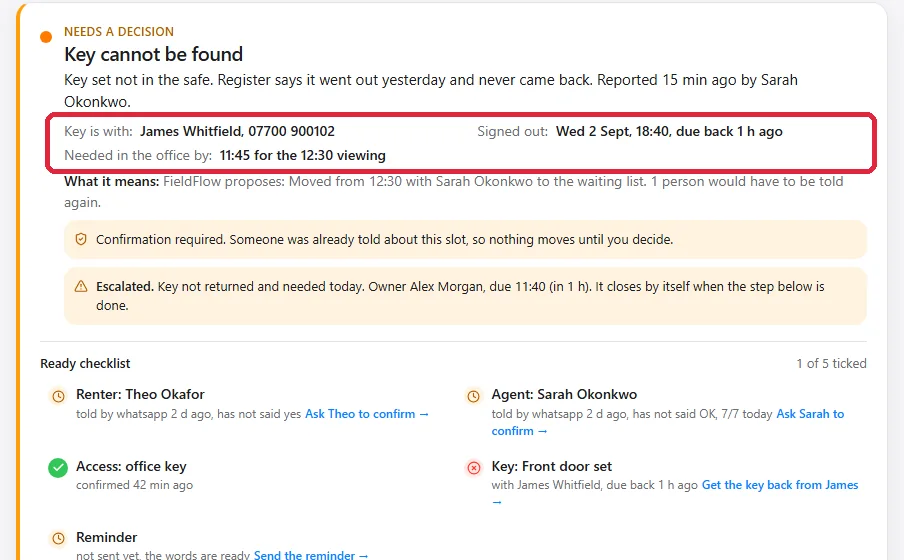
Who has it, their number and the deadline sit at the top of the page. Return the key and every alarm it raised switches itself off.
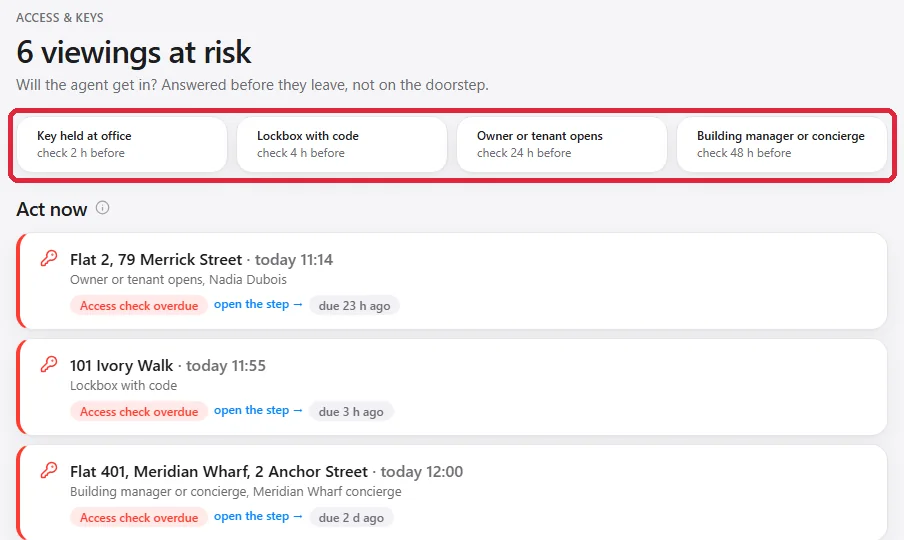
Every door has its own lead time. FieldFlow chases before the agent is on the pavement and turns the call into a verified access in one click.
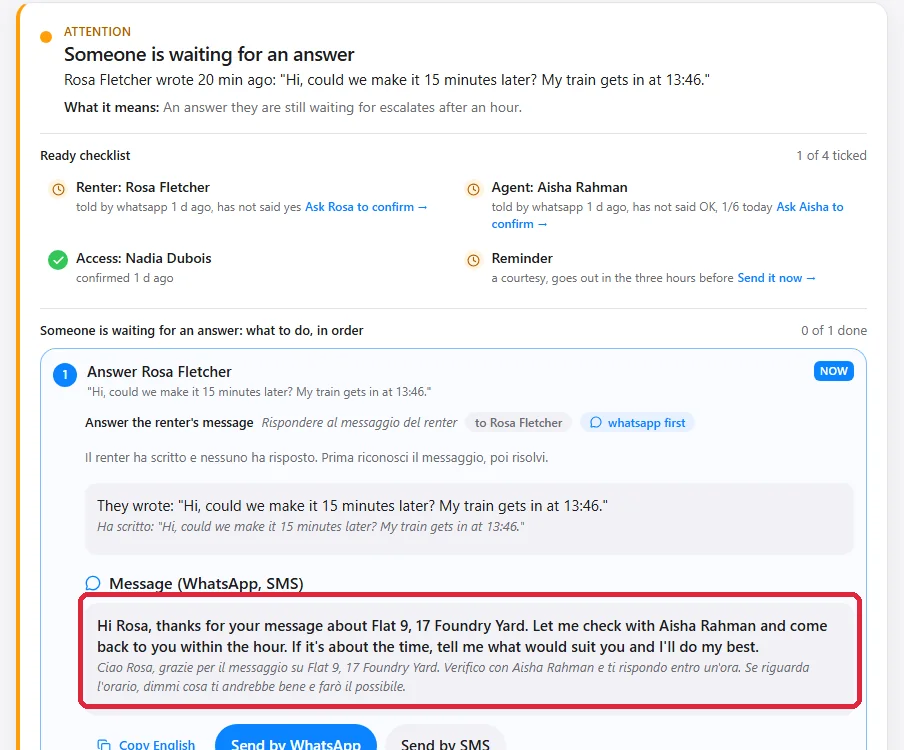
Her reply landed on the viewing's own timeline, not on somebody's phone. The answer is written. Sending it is one tap. Logging it is automatic.
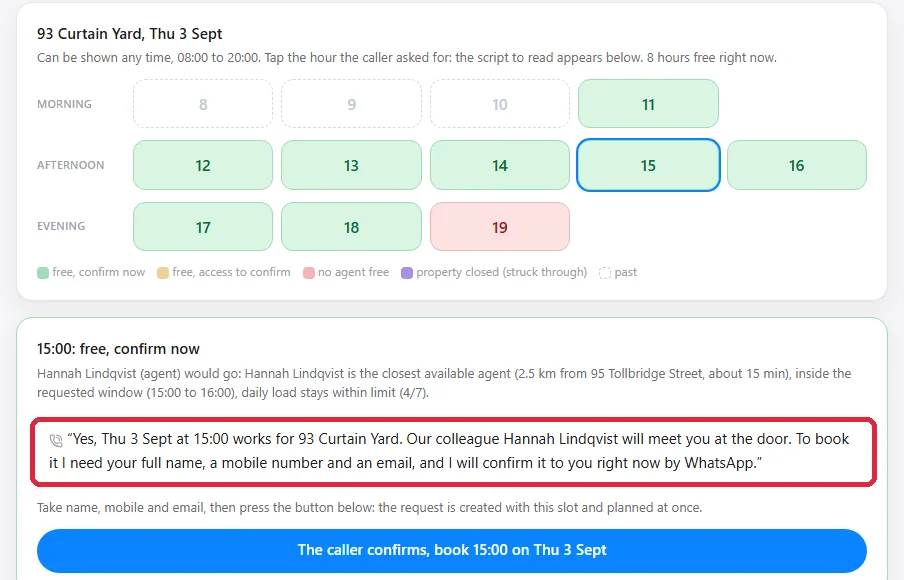
Pick the property, tap the hour they asked for, read the words. The right agent is already chosen and the reason is on screen.
You already know this morning. It has happened more than once.
None of this shows up as one big failure. It shows up as forty small ones, every week.
Pick what goes wrong. The screen is the real product, seconds after it happened.
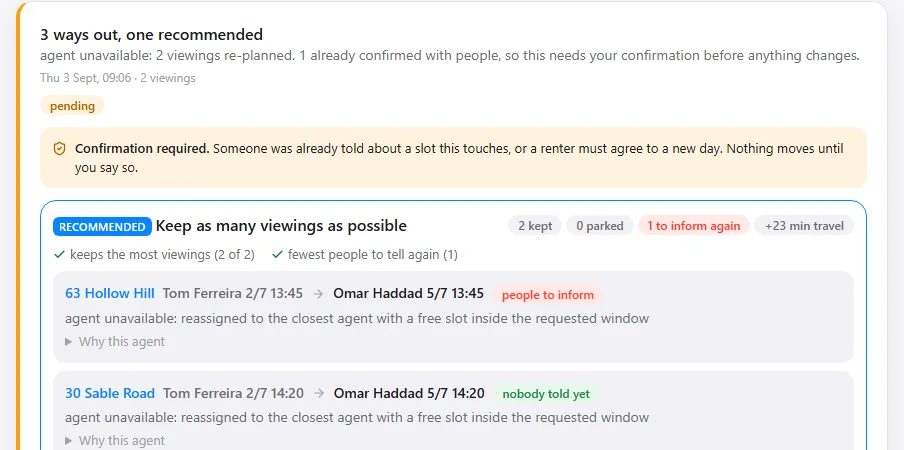
Three ways out, one recommended, every reason written down. Nothing moves until you click.
The freed slot goes to the renter who was already waiting, with the agent who can actually get there. Cost: seven minutes of travel.
Who has it, their number, the deadline. Hold until 11:45 while you call. Return the key and every alarm closes itself.
One record. Everyone reads it. Nothing goes stale.
Every viewing runs on a Viewing Ledger: one event stream that every screen, message and person reads from. Watch Thursday write itself.
Waiting for the first event
The minimal change that fixes it, explained, and nothing executes without your say-so.
Four access types, four lead times, one board that flags the problem the day before.
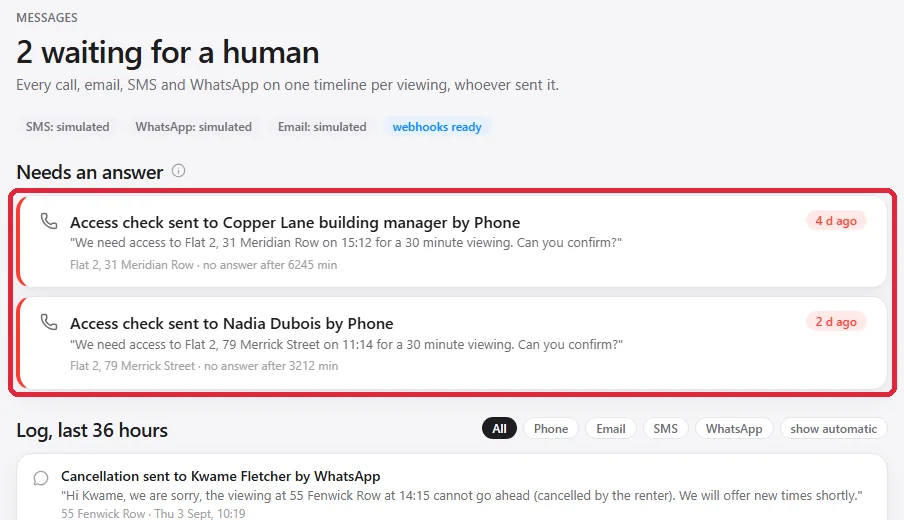
Phone, email, SMS and WhatsApp on one timeline per viewing. Nothing vanishes into somebody's phone.
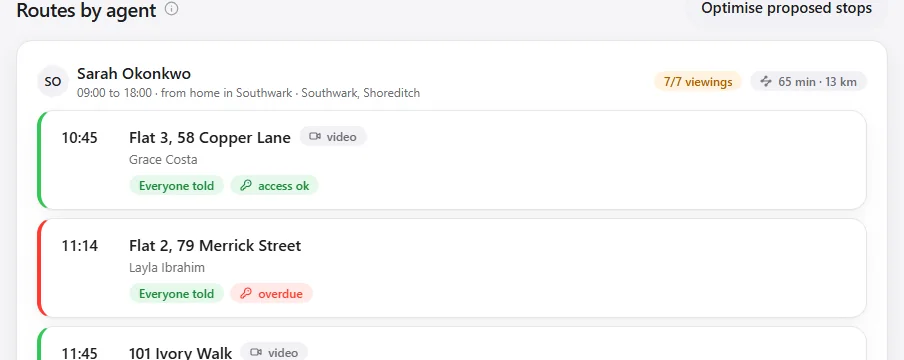
Real TfL journey times, minutes saved shown stop by stop, never a black box.
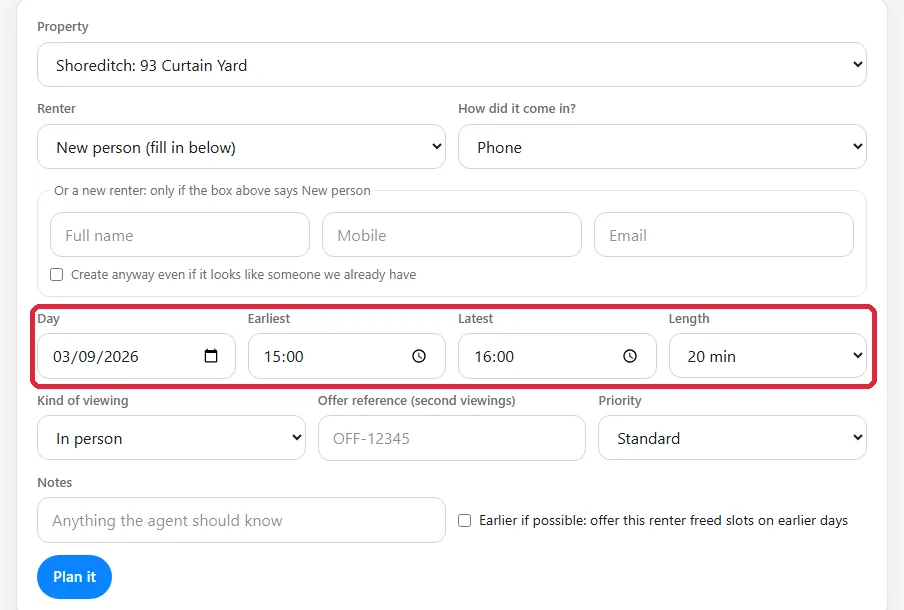
Duplicates caught before the record exists, stale details flagged, validation at the moment of write.
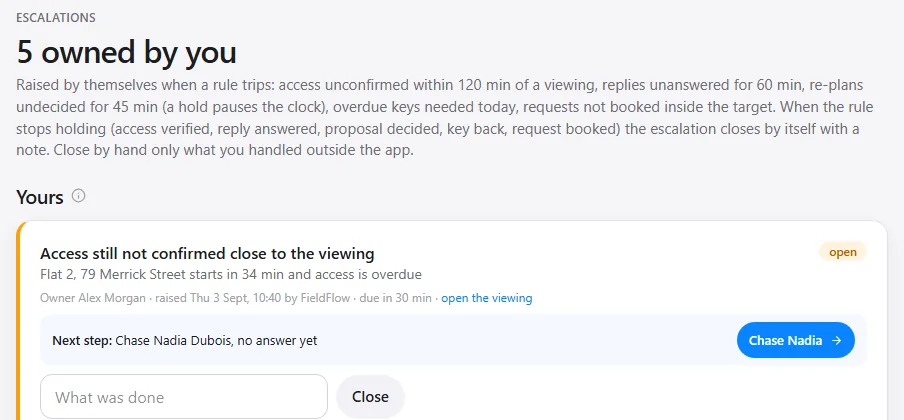
What is about to go wrong, not what already did. Every escalation has an owner and a due time.
Also in the box: a mobile view for the agent on the kerb with one-tap "running late", coordinator scripts for phone, SMS, WhatsApp and email generated from the live ledger (English with Italian gloss), a Sales capacity check before a promise is made, and CSV import for requests, agents and access windows.

One shared state. Every decision explained. Nothing changed behind anyone’s back. That rule comes from years coordinating people and vehicles in real time, then ambulance transport in Sardinia. FieldFlow is that rule, built for a London lettings day.
Built by an operations coordinator. Running today. No logos, on purpose.
One thing to say plainly, once. FieldFlow has not yet run inside a paying agency’s day. There are no client logos on this page because I will not invent them. What there is instead: the product, running, in front of you, on your own scenario. If it does not hold up under your scrutiny, I would rather you tell me in the demo than discover it six months in.
Most software is sold as a roadmap dressed up as a product. FieldFlow runs a full day of viewings end to end, right now, on real routing logic, real access rules, real re-planning under pressure. When you see the engine handle a sick agent, you are watching it happen, not watching someone describe what it would do.
It was not built from a scheduling template with a lettings logo stuck on top. Every screen exists because a specific operational failure exists: the four access types with four lead times, the WhatsApp thread a key handover gets lost in, the moment Sales promises a slot Operations cannot cover.
Personal onboarding caps the cohort. The rate is frozen for life.
A botched viewing at a premium listing does not cost you an afternoon. It costs the landlord relationship you spent three years building. The agencies who join now fix that with a rate that never goes up and a person who answers when they call.
Thirty minutes, your scenario, live in the system. Founding terms are agreed on that call. No payment details, no contract, nothing to sign before you have seen it work.
The five reasons agencies give for not doing this, then the practical questions. Taken one at a time.
Your best agent just called in sick and your coordinator is opening four WhatsApp threads to work out who tells the landlord. That is not a systems problem. That is a today problem. FieldFlow already solved it, live, for a small number of agencies willing to be first.
Not ready for a call? Open the live demo and break the day yourself ↗